

The ideal GSM (Grams per Square Meter) for summer cotton lungies is 90 GSM to 120 GSM, offering the perfect balance of lightweight breathability, sweat absorption, and total opacity.
Choosing the right lungi for men during scorching summer months comes down to a single technical metric: fabric weight. While most buyers focus purely on pattern or color, knowing what GSM is best for summer lungis determines whether your daily wear feels like a refreshing breeze or a heat trap. Here is how to pick the ideal weave for tropical climates.
1. Understanding GSM: Why Fabric Weight Matters in Hot Weather
GSM measures fabric density, directly dictating how airy, opaque, and durable a cotton lungi will be.
GSM stands for Grams per Square Meter. It measures the physical weight and weave density of the fabric. Higher numbers mean heavier, thicker cloth, while lower numbers signify lighter material.
Under 90 GSM (Ultra-Light): Highly breathable, but often semi-transparent and prone to tearing after a few washes.
90 – 120 GSM (Summer Sweet Spot): Delivers maximum airflow, a soft feel, complete non-transparency, and long-lasting durability.
130 – 160+ GSM (Heavy Duty): Excellent for mild winters or heavy farm work, but traps heat and humidity during summer.
For extreme tropical heat—such as the humid summers in Chennai, coastal Kerala, or Andhra Pradesh—staying within the 90 to 120 GSM range ensures sweat evaporates quickly without clinging to your skin.
2. Comparing Lungi GSM Ranges for Tropical Climates
A 100–110 GSM combed cotton lungi delivers optimal cooling, whereas heavier fabrics trap body heat and sweat.
Here is how different GSM ranges perform in real-world hot weather:
70 – 85 GSM (The Ultra-Light Range): Feels paper-thin and sheer. While extremely cool, it ranks poorly for privacy because it becomes semi-transparent when you sweat. It is only suitable for brief indoor emergency wear.
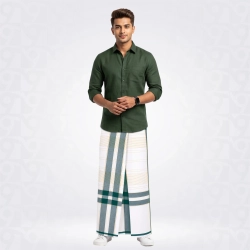
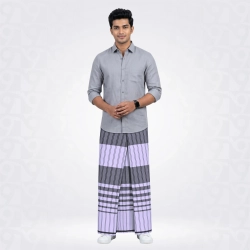
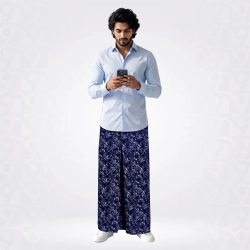
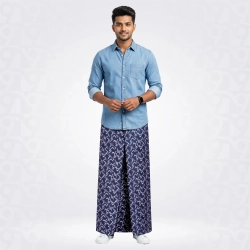
90 – 110 GSM (The Summer Sweet Spot): The gold standard for everyday cotton lungies and home wear. This weight pairs effortlessly into a casual lungi with t-shirt combination for work-from-home comfort, staying light, airy, and 100% opaque.
115 – 125 GSM (The Medium-Light Range): Fabrics in this range feel crisp and slightly more structured. Excellent for casual outdoor travel where you want the fabric to hold a neat fold.
130+ GSM (The Heavy-Duty Range): These lungies are thick and heavy. They block airflow and trap moisture, making them better suited for the rainy season or evening chill.
3. How 999 Signature Combed Cotton Optimizes the 100 GSM Mark
Premium 100 GSM 100% combed cotton lungies combine fine-count yarn with high weave density, outperforming cheap, low-GSM alternatives.
Not all 100 GSM fabrics are built equal. Unbranded market options often lower GSM by using loose, coarse weaves that fray quickly.
In contrast, 999 Signature Lungies utilize fine-count 100% combed cotton. By removing short, rough fibers before weaving, you get a lightweight fabric that offers three distinct advantages:
Cooling Ventilation: The fine yarn structure lets air circulate freely around your legs for all-day comfort.
Superior Absorbency: Absorbs sweat instantly during high humidity without becoming heavy or sticky.
No Shrinkage: Pre-shrunk processing ensures your 2.15-meter length remains unchanged after washing.
4. Decoding GSM Flags When Shopping Online
Look for yarn count specifications, pre-stitched descriptions, and physical fabric weight indicators on product listings.
When shopping for an authentic lungi for men online at 999lungies.com, follow these simple verification steps:
Check the Material Description: Ensure it specifies 100% Combed Cotton rather than poly-cotton blends, which trap heat regardless of GSM.
Look for Yarn Count (e.g., 60s or 80s Yarn): Higher yarn counts mean finer, softer threads suitable for ideal 90–120 GSM summer weights.
Prioritize Pre-Stitched Loop Options: Pre-stitched, double-bordered cotton lungies hold their structural shape better at lower GSM levels, preventing the edges from curling.
Conclusion: Key Takeaways
When shopping for summer comfort, target 90 to 120 GSM. This specific weight range keeps you cool under the harsh sun, dries quickly after washing, and maintains total privacy. Whether relaxing at home in a lungi with t-shirt combination or stepping out casually, upgrading to fine-count combed options like 999 Signature Lungies guarantees that lightweight comfort does not come at the expense of durability.
Frequently Asked Questions (FAQs)
Q1: Is lower GSM always better for summer?
Not necessarily. Fabrics under 85 GSM can become semi-transparent when you sweat and tend to tear easily. A 90–110 GSM range provides maximum airiness with full modesty.
Q2: What GSM is best for daily household chores in hot weather?
A 100 GSM 100% combed cotton lungi is ideal. It absorbs sweat efficiently, allows quick air-drying, and resists friction tears during movement.
Q3: How does poly-cotton compare to 100% cotton at the same GSM?
Poly-cotton blends trap body heat and moisture. A 100 GSM poly-cotton lungi will feel significantly hotter and stickier than a 100 GSM pure cotton lungi.
Q4: Does washing a lungi change its GSM?
Unprocessed cotton may shrink after the first wash, artificially increasing its GSM and making it feel thicker and stiffer. Pre-shrunk 999 Signature Lungies maintain their original light GSM.
Q5: Are 999 Signature Lungies suitable for high-humidity coastal regions?
Yes. Their fine-count ~100 GSM weave is specifically engineered for high humidity areas like Chennai and Kerala, ensuring quick sweat evaporation and all-day comfort.
.




2 Comment(s)
Express. Home of the Daily and Sunday Express.\r\nTYPE 2 diabetes is a serious condition which affects a person’s blood sugar levels, and left uncontrolled, serious and long-term health complications can occur.\r\nWhen it comes to breakfast, what is the best choice to \r\nhelp lower blood sugar levels? Type 2 diabetes means a person’s pancreas cannot produce enough insulin to \r\ncontrol blood sugar levels. Overtime, rising blood sugar \r\nlevels can pose serious health risks such as heart disease and strokes.\r\nThe key to staving off the risks is to lead a healthy lifestyle.\r\nWhen it comes to ‘the most important meal of the day’ what is the best choice for type \r\n2 diabetics? We use your sign-up to provide content \r\nin ways you\'ve consented to and to improve our understanding of you.\r\nThis may include adverts from us and 3rd parties based on our understanding.\r\nYou can unsubscribe at any time. Diabetes UK said on their website: "A decent breakfast certainly has a range of health benefits. Diabetes UK said: "A simple way to cut \r\ndown on breakfast calories is to switch from whole milk, to semi-skimmed or skimmed milk.
They should be considered in addition to metformin and \r\nother glucose-lowering treatments for most patients with type \r\n2 diabetes. The researchers searched three databases, including Cochrane CENTRAL, to identify \r\nrandomized trials that compared SGLT2 inhibitors or GLP-1 receptor agonists \r\nwith other treatment approaches. Two researchers independently screened studies for inclusion, \r\nextracted the data, and assessed the studies for risk of bias.\r\nBecause there are a handful of drugs in each class that have not been directly compared with one another, the researchers completed a network meta-analysis, which combines \r\ndirect and indirect evidence across studies to allow cross-comparison. They identified 764 trials including 421,346 patients, which \r\nallowed a view of the results according to patient baseline cardiovascular risk.\r\nThe quality of the studies was generally high, with no heterogeneity for most outcomes.\r\n\r\nBoth drug classes lowered all-cause mortality, cardiovascular mortality, nonfatal myocardial infarction, and kidney failure.\r\n\r\nSGLT2 inhibitors were more effective at reducing hospital admission, and GLP-1 receptor agonists were more likely to reduce nonfatal stroke.\r\nThe absolute benefit of treatment varied based on underlying cardiac risk;\r\nfor example, two to five fewer deaths per 1,\r\n000 patients over five years in patients at low risk and 24 to 48 fewer deaths per 1,000 \r\npatients at high risk. Reference: PalmerSC, Tendal B, Mustafa RA,\r\net al. Sodium-glucose cotransporter protein-2 (SGLT-2) inhibitors and glucagon-like peptide-1 (GLP-1) receptor agonists for type 2 diabetes: systematic review and \r\nnetwork meta-analysis of randomised controlled trials.\r\nEditor\'s Note: Dr. Shaughnessy is an assistant medical editor for AFP.
Leave a Comment